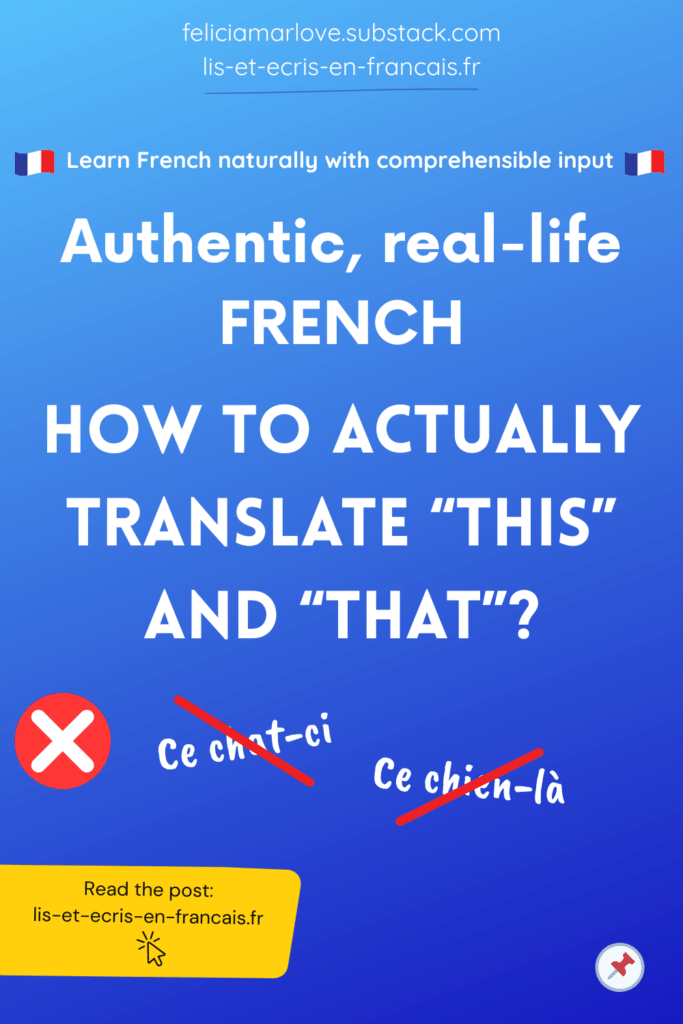
As a native French speaker who loves learning foreign languages, I’ve noticed a difference between French and many other languages (like English, Japanese, Spanish, Dutch…): in French, we usually don’t specify the distance between us and the object or being we’re talking about.
This object or that object? What native French speakers say…
In many languages, the distance between the speaker and the thing being mentioned is specified by a different determiner.
For example, if we translate the sentence “Ce chat-ci ou ce chat-là ?”:
- Deze kat of die kat? (Dutch)
- This cat or that cat? (English)
- この猫かあの猫か / この猫かその猫か (Japanese)
- ¿Este gato o ese gato? (Spanish)
What about your mother tongue, if it’s different from these?
In those languages, there is no “neutral” way to point something or someone without implying a physical distance.
French is different, because our determiners, “ce”, “cet”, “cette”, “ces”, don’t hold any value of distance. If we want to express it, we have to add “-ci” or “-là”, but it doesn’t come naturally in most sentences.
Talking about an object or a being: how to correctly use “ce / cet / cette / ces”
If you want to sound like a native, most of the time, you’ll have to drop the “-ci” or -là”, that are often just a very literal translation. In everyday French, we only specify this “distance” when it’s necessary.

Translating this/that/these/those naturally in French
- This cat looks sick => Ce chat a l’air malade
- That dog is scaring me => Ce chien me fait peur
- These oranges look juicy => Ces oranges ont l’air juteuses
- Those teenagers are up to no good => Ces adolescents ne font rien de bon / Ces adolescents n’ont que des mauvais plans
When to actually use “-ci” and “-là” in French?
Those suffixes are useful when some confusion is possible. For example, let’s say I’m at the bakery and I’m asking for some pies that I’m seeing through the window:
- (client / cliente) : Elles sont à quoi ces tartelettes ?
- (boulanger / boulangère) : Lesquelles ?
- (client / cliente) : Celles-là (sous-entendu, « loin de moi ») / Celles-ci (sous-entendu, ici devant moi) / Celles-là avec la crème jaune / Celles-ci avec la poudre de cacao au-dessus / …
Translation:
- (customer): What are (these/those) small pies made of?
- (baker): Which ones?
- (customer): Those ones (implying “those far from me”) / These ones (implying “the ones right here in front of me”) / These with the yellow cream / Those with cocoa powder on top / …
The translation into English makes less sense, because the first question would already mention “this/these” or “that/those”, reducing the need to be more precise afterwards.
Here’s another use case:
- (mon ami / mon amie regarde les livres dans ma bibliothèque) : Tu as déjà lu tous ces livres ?
- (moi) : Non, seulement ceux-là (en faisant un geste pour montrer ce à quoi correspond « là »)
Translation:
- (my friend, having a look at my bookshelves): Have you read all those books?
- (me): No, only these ones (making a gesture to actually show which “these” are)
In French, is there really a difference between “-ci” and “-là”?
In French, we tend to use “-là” by default, even when there is a really short distance between us and the thing we’re talking about. Let’s review previous example:
- Tu as déjà lu tous ces livres ?
- Non, seulement ceux-là.
It would make more sense to say “ceux-ci” (you might have noticed I translated to “these ones” in English by the way), because we’re both close to the books, but it’s not actually important because there’s no possible confusion, no comparison between something that’s far and another thing that’s closer. In French, it’s then natural to default to “-là” (although you could hear both).
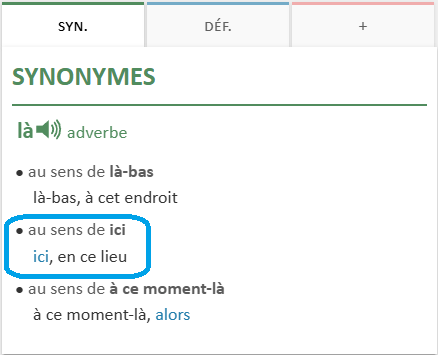
You can see in the French dictionary LeRobert that they list “ici” (here) as a synonym of “là” (there).
Summary: How to translate “this” and “that” in natural French?
In everyday life, we’re hardly ever using the literal translation of “this” and “that” in French. The determiners “ce”, “cet”, “cette” (depending on gender and first letter for masculine nouns) or “ces” (plural) don’t hold any value of distance and we use them on their own in most cases.
- That garden => Ce jardin
- This object => Cet objet
- That woman => Cette femme
- These books => Ces livres
- Those students => Ces étudiants / Ces étudiantes
We specify “-ci” and “-là” when we want to avoid confusion, or want to emphasize which thing we’re talking about.
- I don’t want that pie, I’d rather have this one => Je ne veux pas cette tarte-là, je préfère celle-ci.
- Do you mean this one? => Tu veux dire celui-ci ?
Really often, we’re using “-là” to stress on what we’re talking about, even though the thing or being is close to us (especially when there’s no risk of confusion).
- (Placing a object in front of someone) I put this here => (En déposant un objet devant quelqu’un) Je mets ça là / Je pose ça là
- (Holding a CD in my hand) Can I borrow this one? => (Avec un CD dans les mains) Je peux t’emprunter celui-là ?
I hope you liked this practical guide! Please leave your questions in the comments and don’t hesitate to propose ideas for next posts.